What do we get in exchange for our work? There’s pay, of course, and the satisfaction of a job well done. There’s stress and human interaction, learning and physical exertion. We get the drama of what might happen next and the delight of actually pulling it off. And mostly we get the day to day.
I haven’t seen any data that says that working in accounting for a candy company is more fun or more satisfying than working in accounting for an insurance company.
And even circus clowns get bored at work.
It’s easy to be excited about what the company seems to do… to choose our path based on the public’s perception of the output. But once the company has more than one person in it, most of our day is about satisfying the customer, meeting supplier requirements and dancing with the tension of doing our jobs.
Often, we use the product we make as a reason to tolerate the process we don’t enjoy.
Perhaps it makes sense to outline the sort of process you’d like to fill your days with instead of being drawn to the product that caught your eye in the first place.
The early adopter bought an iPhone in 2008 and never looked back. They played a few games of pickleball and then joined a club and bought the equipment. They picked up a new magazine on the newsstand and then subscribed, and they bought the new bestseller and then read the author’s other works.
The dilettante shows up early and often, but then moves on.
The early adopter and the dilettante both try out the new tech, but only one sticks around through the dip, learning from the hard parts.
The dilettante seeks out new experiences, but the early adopter adopts.
Culture needs both.
Marketers need to be aware of the different personas, and plan accordingly.
If you push for trial but don’t create the conditions for subscription and persistence, don’t be surprised if only the dilettantes show up. That might be enough, but we need to choose the audience we seek.
I’m told that the hardest part of being a teaching golf pro isn’t helping adult golfers develop a good swing.
It’s getting them to stop using a bad one.
Our position feels so fragile, we hold on very tightly.
Competence, status and connection are fleeting yet hard-won. We can often feel like an impostor and one way to find peace of mind is to fortify the foundation of what we believe got us here.
And so we close up.
Alas, it’s almost impossible to pick up something when your hand is in a tight fist.
This is why emotional enrollment is the key to learning. No toddler learned to walk by insisting, again and again, that crawling was good enough. Or by trying to walk by simply crawling harder.
Teachers (leaders/organizers/coaches) have two jobs. The first is to earn enrollment, the second is to teach.
If the student is unwilling to become open, afraid to let go of what they’re holding on to, then better is going to be elusive.
Resistance is wily. It will come up with a thousand reasons to remain closed, narratives about entitlement, security or cultural dynamics. Whatever it takes to stay still. Extinguish one and another will replace it.
When we’re in the middle of a cultural swirl, it’s normal to believe that everyone else is too.
That’s part of the magic of a cultural swirl–it’s our friends, our work, our world.
Most of these moments are actually tiny pockets. An episode of the much-talked-about TV show Succession was seen by about 3,000,000 people when it aired, compared to an episode of Gilligan’s Island or the Monkees, which reached fifteen times as many people in the US with each episode.
And the US, of course, is about 5% of the world.
The size of the swirl doesn’t have to change the way it makes us feel if we’re in the middle of it. If you were one of the half a million people at Woodstock, or the 7,000 who saw the Dead play in Binghamton, that moment belongs to you and the people there. But that doesn’t mean it’s universal. It might be important to the people there precisely because it isn’t.
Over time, the Beatles sold more than a billion dollars in albums. They made movies, transformed hairstyles, clothing and attitudes about generational shift. Their work connected people worldwide in a way that few cultural forces before them had and few have since.
And it probably felt just as exciting to see them live as it did to go to a Taylor Swift show.
It’s true that no Taylor Swift album has outsold the hit albums by Hootie & The Blowfish or Metallica. But the long tail has transformed the record business since its peak.
And the long tail keeps getting longer. The singular cultural touchstones of a generation or two ago are unlikely to be repeated. Our experiences with worldwide events or local performances are now much less likely to be uniform.
We all tuned into the same channels. Then we didn’t.
Marketing is generally about action. Marketers seek to create the conditions for a change to happen, for people to accomplish their goals and to satisfy their needs.
But since 1950, some marketers have worked in a different direction. To sow confusion and doubt, and most of all, to seek delay.
In 1954, facing the real threat of peer-reviewed and clear evidence that smoking caused lung cancer, the cigarette industry startled pundits by acknowledging the research and then calling for more research.
“More research” is a brilliant (if evil) tactic. It resonates with people who embrace science (since it calls for more) and it also works for people who want the status quo to remain untouched (because it calls for later).
We’ve seen this playbook used again and again. In the face of reality, big companies simply stall. And they’ve discovered that when the problem is chronic, nuanced and complex, they can stall for a very long time.
Because we choose to not understand. We’d prefer to pretend that we can wait. We accept that maybe, more research will pleasantly surprise us.
As long as people don’t understand, the stalling works.
Spending more than a year working as a volunteer with hundreds of other people on The Carbon Almanacgave me a chance to really understand what is happening to our climate. Not just to the weather (10 days in a row over 119 degrees in Phoenix)… to the climate. To see that the best time to act was thirty years ago, but now is all we have left.
It’s easy to be confused, but it’s not that difficult to understand. It’s all in the almanac.
The new CEO of Shell just announced that the company is redoubling its efforts to produce ever more fossil fuels. Because there’s money to be made in the short-run. And because the public doesn’t see.
Until we understand, it’s difficult to make change happen.
The good news is that understanding is within our reach.
[a note to a frustrated friend, just starting out on a long career]
There are three reasons that our goals might not be achieved. In order of palatability, they are:
Perhaps the goals are too lofty, too based on chance, unlikely for anyone to achieve, surrounded by barriers that are rooted in class or caste, or simply unrealistic.
If that’s the case, change expectations and/or pick different goals.
Or, perhaps the goals are useful, but we need more persistence, more time and some hard-earned lucky breaks along the way.
If so, be persistently patient.
Alas, if it’s not these two, the most likely reason is that we need to walk away from our expectations and our insistence that we’re already doing the work perfectly. It could be that we need to expend more effort than we hoped, develop new skills, find and embrace new strategies and develop a taste for the emotional labor that’s required to get from here to there.
Empathy, a cycle of skills improvement, developing new attitudes and showing up in service often accompanies the careers of people who get from here to there.
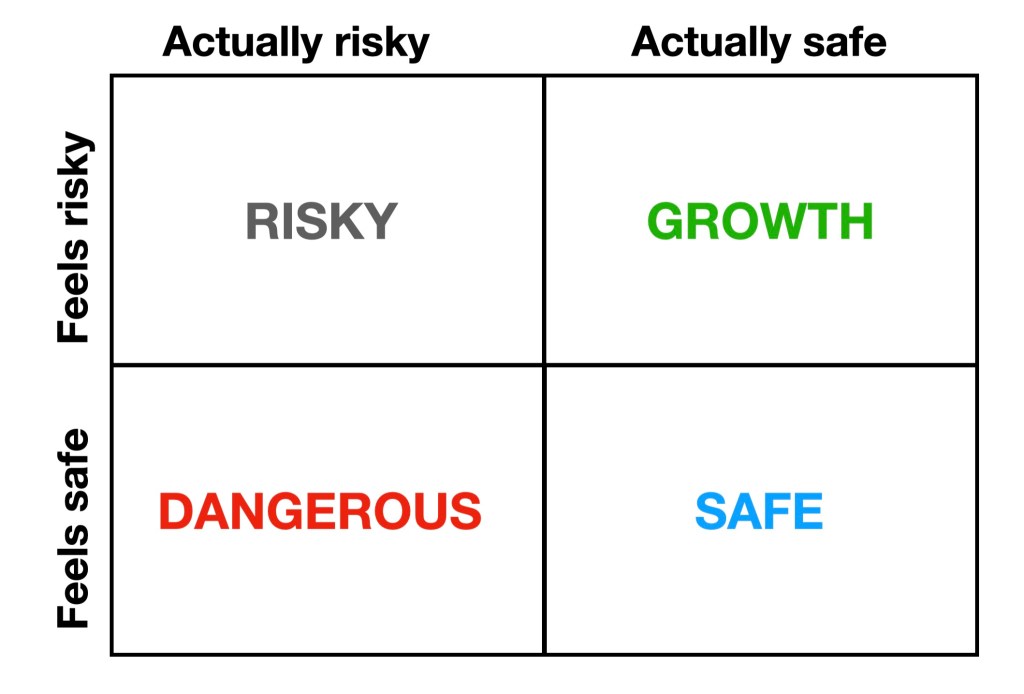
Growth usually feels risky. The feeling is a protection mechanism, a way to avoid failure or even the fear of failure.
Of course, risk also feels risky (or at least it should). Differentiating between the two is difficult, which is why finding institutions, methods or coaches that have experience in the difference is valuable.
When we create the conditions for supported tension–the feeling of ‘this might not work’–we give people the chance to grow.
July 18, 2023
Privacy & Cookies: This site uses cookies. By continuing to use this website, you agree to their use.
To find out more, including how to control cookies, see here:
Cookie Policy